AI Investment: Future or Bubble
Background of the story
Artificial Intelligence has become the hottest trend across the global industry. From Silicon Valley’s giants to mid-size start-ups, AI has been the main focus of products, articles and investor call. But over the past year, major institutional funds have voiced a new worry: is AI becoming a bubble?
For the first time in two decades, global fund managers report that companies may be overspending on AI. Billions of dollars were invested into research, infrastructure and model training, while the real-world impact remains unclear.
This analysis follows the money, utilizing global data from the OECD (sourced from Preqin). OECD.AI estimates venture capital (VC) financial investment in AI and data firms worldwide based on private-source data from Preqin, processed by the AI lab of the Jožef Stefan Institute, Slovenia, and analysed by the OECD.
Key questions
Is total AI investment still growing, or is it slowing down after a decade-long rise?
Which industries receive the most investment: human-centered areas like healthcare and education, or business-driven fields like IT and infrastructure?
How have different industries’ investment trends changed over the decade? Which sectors are booming—and which ones are cooling down?
Key findings (with visuals)
1. Global AI investment increased rapidly
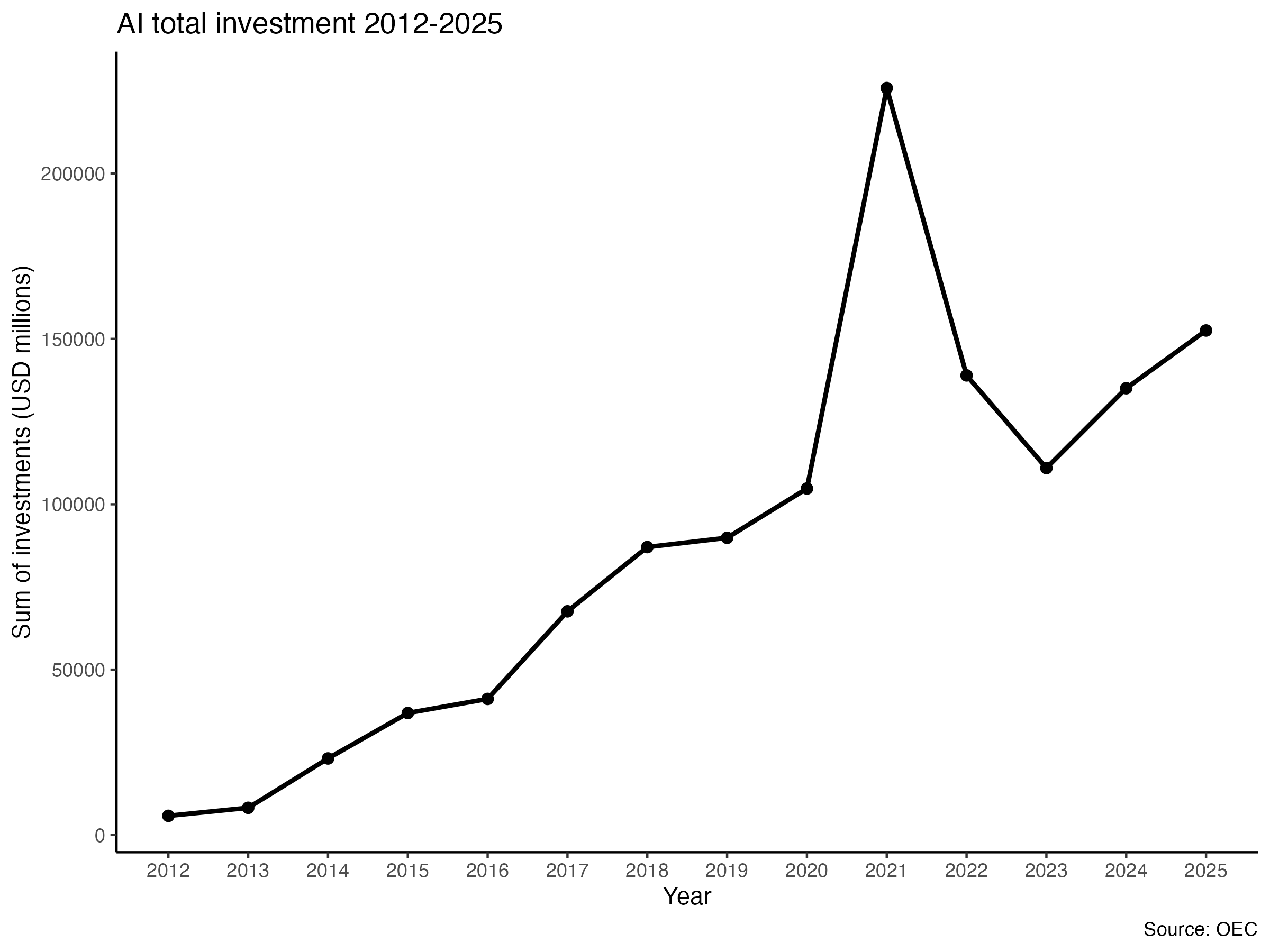
Between 2012 and 2018, total global AI investment showed a steady increase. From 2019 to 2021, investment experienced its fastest growth, reaching its highest level with over 20,000 millions. After a drop between 2021 and 2023, total annual AI investment continuously grew.
2. Most AI money still goes to business infrastructure
IT infrastructure and hosting receives the largest amount of investment with about 56141 million US dollar, which double the investment of the second place, Media social platforms and marketing with about 28147 million.
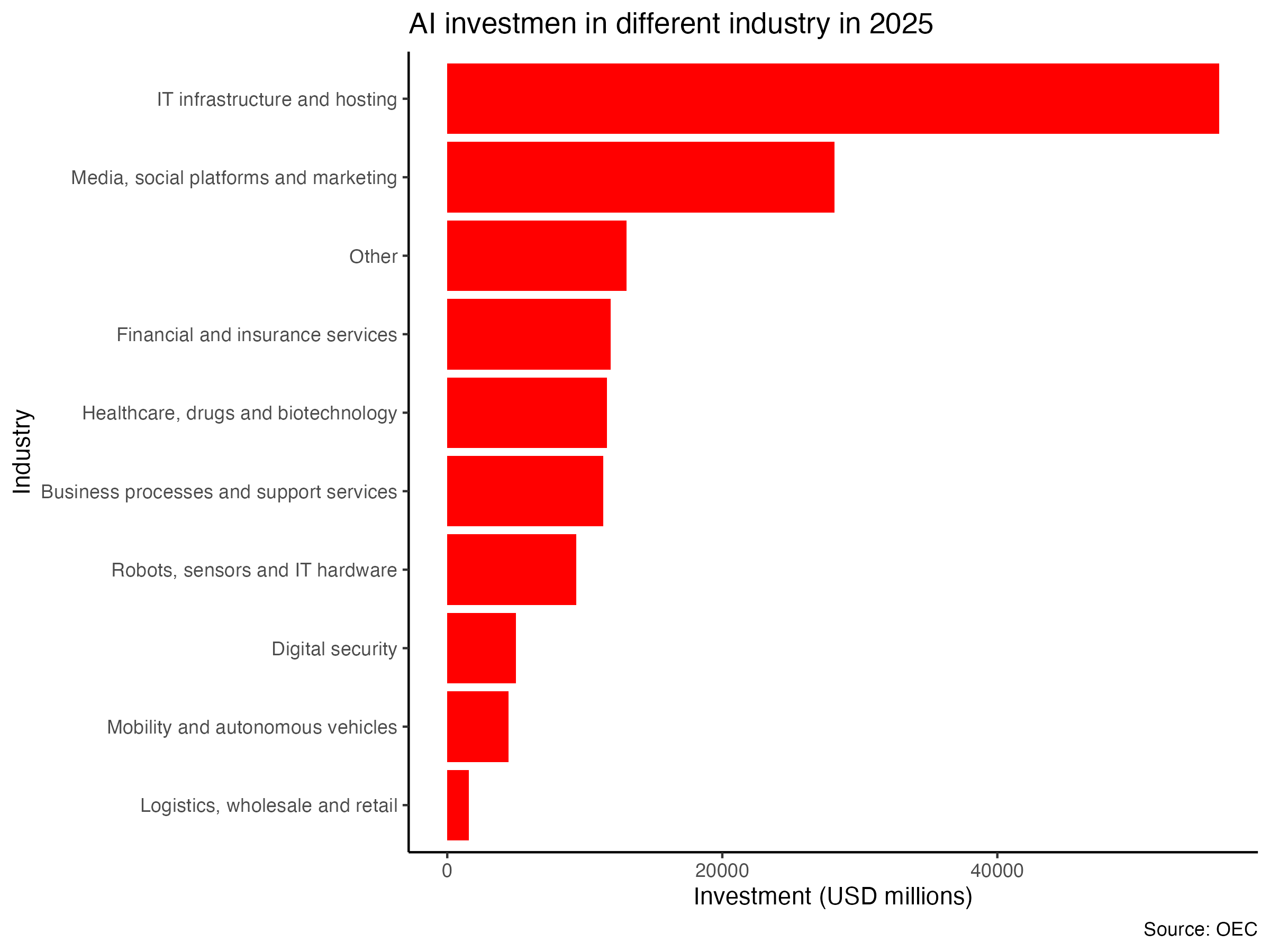
Most AI investment are not funding industries that directly related to ordinary people, such as medical AI or education tools. Instead, money is flowing into business-driven fields like data centers, cloud computing or model training hardware.
3. Different industries show distinct investment patterns
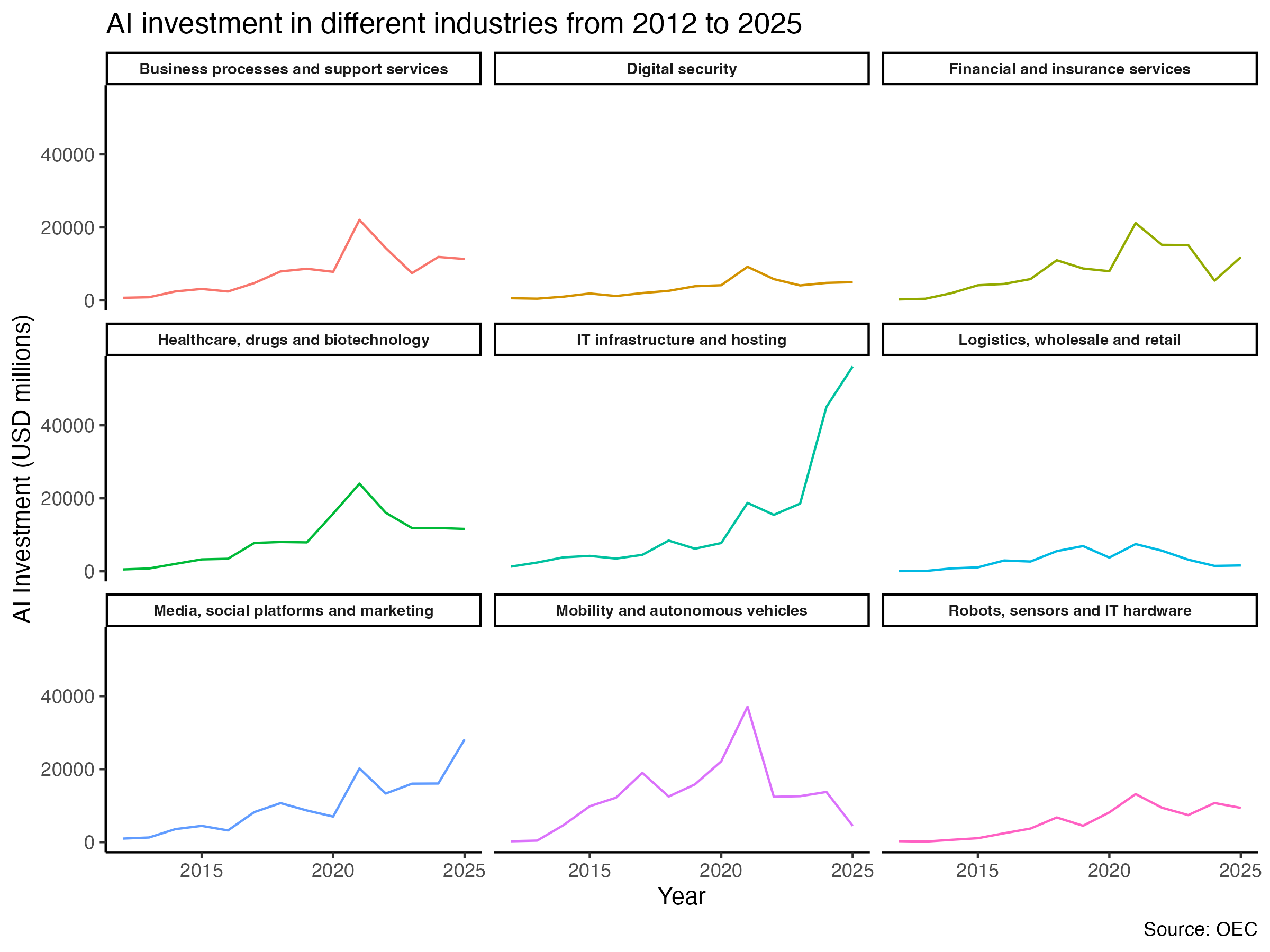
For IT infrastructure and hosting, investment increases steadily from 2012 and shows the largest rise between 2021 and 2025.
For Mobility and autonomous vehicles, investment sharply decreases after 2021.
For most industries, investment grow stable and moderate.
Summary
AI investment has grown fast, but the money isn’t spreading evenly. Most funding now flows into infrastructure and computing, while industries that shape daily life such as healthcare receive less.
The key question is whether future investment will move beyond the technical backbone and toward areas that benefit more people. AI’s impact will depend not just on how much money is spent, but on where it goes next.